The running costs an AI quote leaves out
The quote prices the build, but after launch you pay a usage bill that follows your volume, and for a retest each time the model underneath is retired. Get both in writing before you sign.
On this page
It costs more than the quote says, because a proposal for an AI system usually prices the build as one number, and that number is the part you can see coming. Then the system goes live. From that day you pay a usage bill that goes up and down with how much work it handles, and the quote can't tell you what that will be. You also pay for someone to retest and adjust it whenever the AI model it runs on is retired. That comes round fast. For two of Anthropic's Sonnet models, retirement came thirteen to fourteen months after release. If you run a firm of 30 to 200 people, I'd want both of those priced in writing, next to the build, before you sign.
On 6 November, TechTarget reported on a Forrester session in New York about controlling AI spending, and the session opened with someone in the audience describing a surprise invoice from OpenAI, where a single month came to roughly what the organization normally spent in a year. That company had a technology function and a budget process, and the bill still caught it out, so I wouldn't assume a smaller firm with one IT person would spot it any sooner.
A company can know exactly what a provider charges per unit of usage and still have no idea what the month will cost, because the amount of work the system does to finish a task changes every time it runs. Kevin Ogunsua, the Forrester analyst running the session, put it in one line: "You don't know what your bill is going to be like."
Which costs sit outside the build?
A quote for an AI build covers designing the system, connecting it to your tools and getting it working on examples. That's real work and it should be paid for. But it happens once, and it's the only cost the vendor fully controls, which is why it's the easiest one to put on a page.
The running bill works differently. Most software you've bought was priced per seat, so forty users meant forty licences and the number barely moved from one month to the next. AI systems built on a model are usually charged by usage instead, which means the bill follows the amount of work going through them. Hire ten people and it may stay flat. Win a large new contract and it can jump in the same month.
Then there's the cost of keeping the system working. The model it's built on gets retired on the provider's timetable, and your staff spend time checking what it produces. Somebody also has to update it when your own process changes. Those costs sit outside the build, so they rarely show up on the quote.
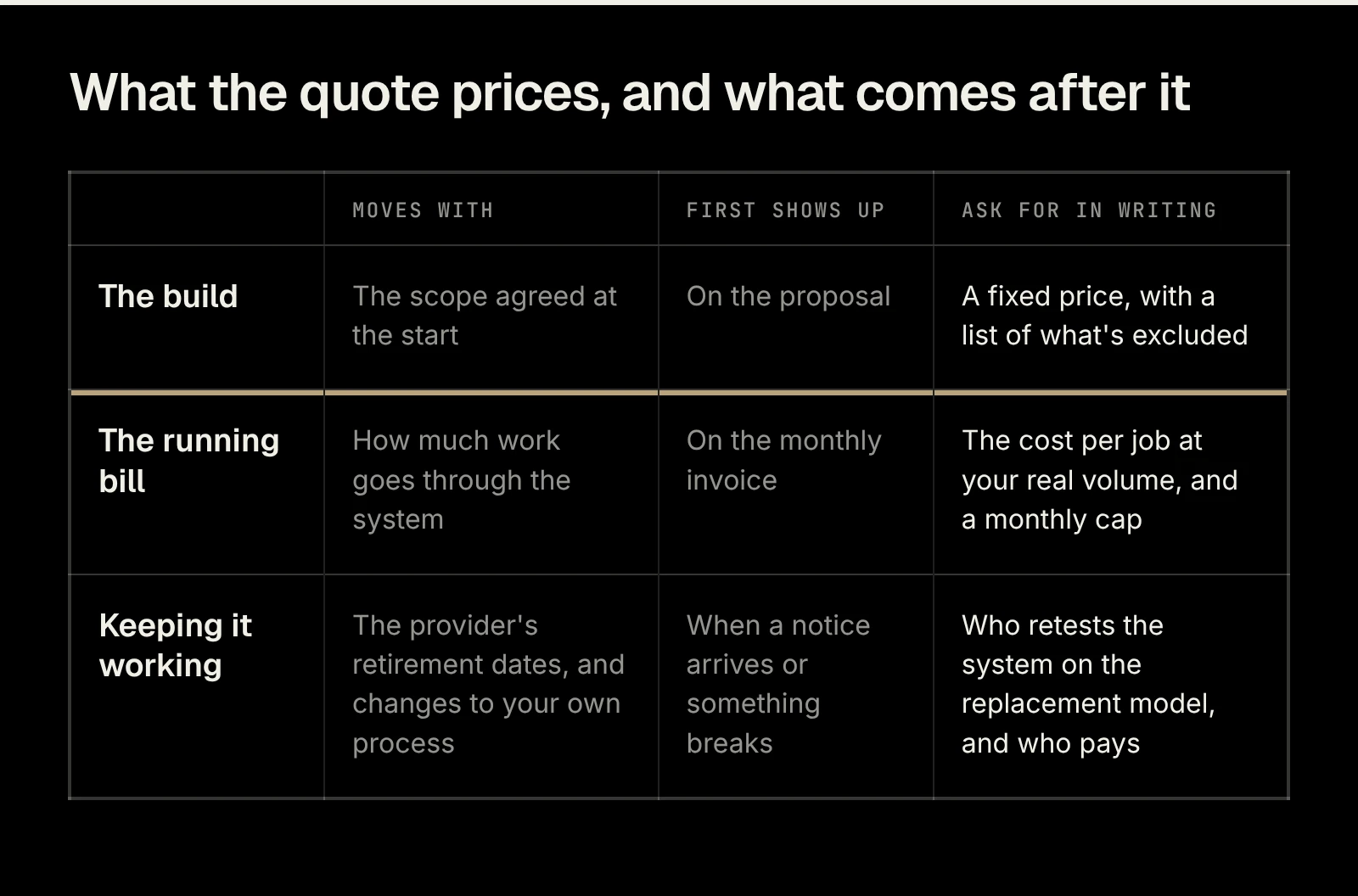
Does the bill follow headcount or volume?
Volume, and the reason is in how agents work. Ogunsua described how one request to an AI agent can be answered with a single call to the model, while a harder request might take several calls, or the agent might bring in other agents, each of them adding usage. I'd want every owner to picture that, because it means the cost of one job depends on how messy the job is.
Say you run an air conditioning service company in the Gulf, and a system reads every incoming service request and drafts the job sheet. A clear request with the unit model and the fault might take one pass. But a request with three photos, a half remembered model number and a complaint about the last visit could take several passes plus a search of the customer's history. Summer is the busy season for AC repairs there. The messy requests peak then too, which means the bill climbs fastest in exactly the months your team is stretched.
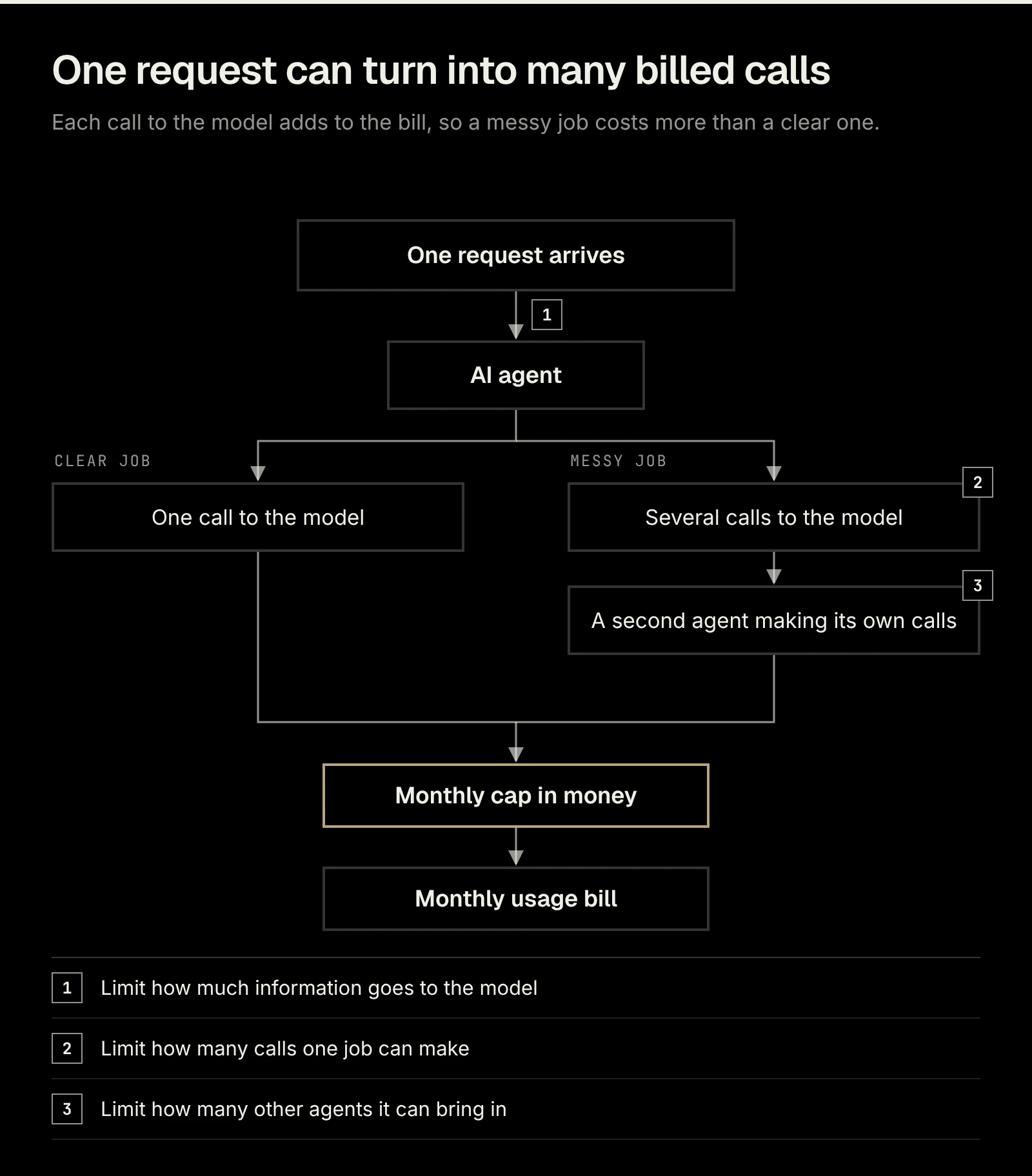
Forrester's advice was to limit how much work an agent can do on each request. That means capping how much information goes to the model, how many model calls one job can make, and how many other agents it can enlist. I agree with all of it. But I'd add one limit that sits above them, and it's a monthly number in money.
Should there be a cap in the agreement?
I'd put one in, and I say that because I run one myself. Several AI assistants do research work inside Zach AI, and their paid lookups share one limit of US$1.50 a day across all of them, with every paid call logged against that total, so when the next call would take the day past the limit, they stop. I kept it small. That way the worst day I can have is a figure I picked in advance, instead of one I find out about later.
For a system running inside your company, I'd write a monthly number into the agreement, plus a limit for any single job. Then I'd ask what the system does when it reaches the cap. A system that stops and drops the remaining work is the version I'd refuse. The better design stops and puts what's left in front of a named person, so a heavy month makes your team a few days slower and no customer request disappears.
I'd also want an alert well before the cap, sent to whoever signs the cheques as well as the person who built it.
Can the model under your system be retired?
Yes, on the provider's schedule, because every AI system runs on a model from a provider such as OpenAI or Anthropic, and those providers retire older models when they choose.
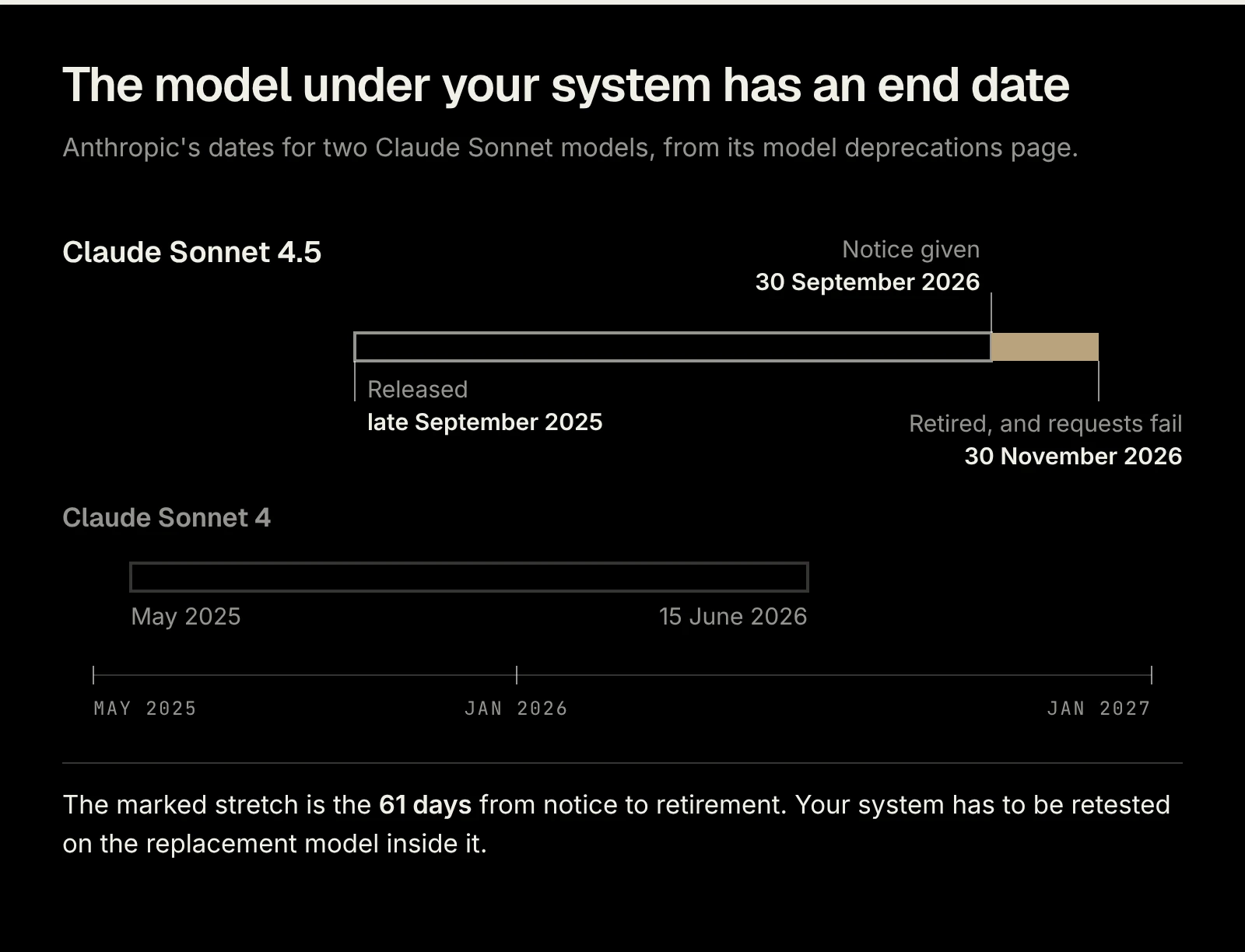
Anthropic's model deprecations page shows what that looks like. On 30 September 2026 it told developers that Claude Sonnet 4.5 would retire on 30 November, 61 days later. That model came out in late September 2025, so it will have been available for about fourteen months, and Claude Sonnet 4 went the same way earlier this year, released in May 2025 and retired in June 2026. After a retirement date, the page says, requests to the old model fail, which means a system still pointed at it stops on that date.
Anthropic promises at least 60 days' notice, and it tells developers to test their applications on the replacement well before the date. It's good advice. But it also tells you where the cost is. A replacement model can read the same instructions differently, so a system that behaved well before the switch can give different answers after it unless someone has retested it on your real work.
If an outside vendor built your system, that someone is either the vendor, at a fee you haven't agreed yet, or nobody.
So before signing, I'd ask which model the system runs on and when its provider expects to retire it. Get the date in writing. I'd ask who retests the system when that happens, and whether the retest is in the price. Then I'd ask whether the instructions and test examples live in files your company owns, because if they do, another builder can pick them up.
I'd push hardest on that last question. In my own work I want my context free of any one provider, so that if I move from Claude to GPT, everything the system knows about my business comes with me. Your company deserves the same. A vendor who keeps your instructions and examples in a format only they can use has made you dependent on them without ever saying so.
Is checking time part of the cost?
It is, and your own staff pay it in hours. A system that drafts customer replies or job sheets still needs someone to read what it wrote before it goes out, at least for the first months, and that reading is paid time. If a vendor's savings figure assumes nobody reads the output, it's counting hours your team will still spend.
I'd ask for the checking time to be estimated on the same page as the time saved, and I'd expect it to shrink as the system proves itself on your work. I've written about checking an AI answer before you act on it, and the same habit applies here. Someone named owns the check, and their hours belong in the cost.
Your own process will change as well, and each change means somebody has to update what the AI system was told, whether that's a new price list or a move to a new supplier portal. It's small work. But it has to be somebody's job, or it turns into a surprise invoice from whoever gets called in to fix it.
Won't AI keep getting cheaper?
Per unit of usage, it has. I still wouldn't plan on the bill falling, because the systems being sold now do far more work per task than a person typing questions into a chat window. That was Ogunsua's point too. Knowing the price per unit tells you little about the bill while the amount of work per task keeps changing.
A cheaper replacement model also comes with the same retest. You'd still want someone to confirm it handles your work before you switch, so the saving on usage arrives with a piece of work attached.
Before you sign the next AI proposal
When the next proposal lands on your desk, I'd send it back with one short note. In it, ask for the cost of a typical job and of a messy one at your real monthly volume, and for the monthly cap and what the system does once it hits it. Then ask which model it runs on and who pays for the retest when that model retires. A good builder answers on one page. The ones who can't haven't thought about your second year.
I'd rather you could judge those answers yourself than take my word or a vendor's for them. If that's worth a conversation, you can book one through Private AI Capability, where our team works with you one to one for six weeks on your own tasks until you can read a proposal like this and price it yourself.
FAQ
- Can a builder tell you what an AI agent will cost each month?
- Only once they know your volume, because the bill follows how much work the agent handles and how many model calls each job takes. Ask the builder to price a typical job and a messy one, multiply both by your real monthly volume, and put a monthly cap in the agreement.
- Does a system stop working when its AI model is retired?
- It does, until it's moved to a replacement, because requests to a retired model fail. Anthropic gives at least 60 days' notice. The system should be retested on your real work before the switch, and your agreement should say who does that and who pays.
- Is a fixed monthly fee safer than paying for usage?
- It moves the risk to the vendor, which can be worth paying for. But the vendor will either price that risk into the fee or limit how much work the system does. Ask what happens in a month when your volume runs over, and whether the retest after a model retirement is included.