The one part of AI an owner can't delegate
Owners keep handing AI decisions to whoever sounds most sure. I think the judgment behind those decisions has to stay with the owner.
On this page
If you've run a company for twenty years, you've made thousands of calls about things you couldn't do yourself. You hired an accountant without being one. You've signed contracts you needed a lawyer to read. That works because over time you built enough judgment to tell when someone is good at their job and when a price is wrong.
Around AI, I don't think the typical owner has that yet. And since delegating has worked for them their whole career, they delegate this too. The IT manager gets it, or the bright junior who lives on ChatGPT. Some owners bring in a consultant, and others wait for a vendor to turn up with a proposal.
That's the handoff I'd argue against. You can give away the AI work itself. But the calls about that work have to stay with the person who owns the business, and right now that person is often the one in the room who understands it least.
An accountant is easier to judge than an AI proposal
When you hire an accountant, the decisions you make about them are narrow. Are they competent and honest, and is the fee fair? You can judge that from outside the profession.
AI decisions spread into everything. Picking which process to automate is a call on where your bottleneck sits. Picking a vendor decides who you'll depend on for years. Even telling your team to "use more AI" sets a standard for what good work looks like in your company, and you've set it whether you meant to or not.
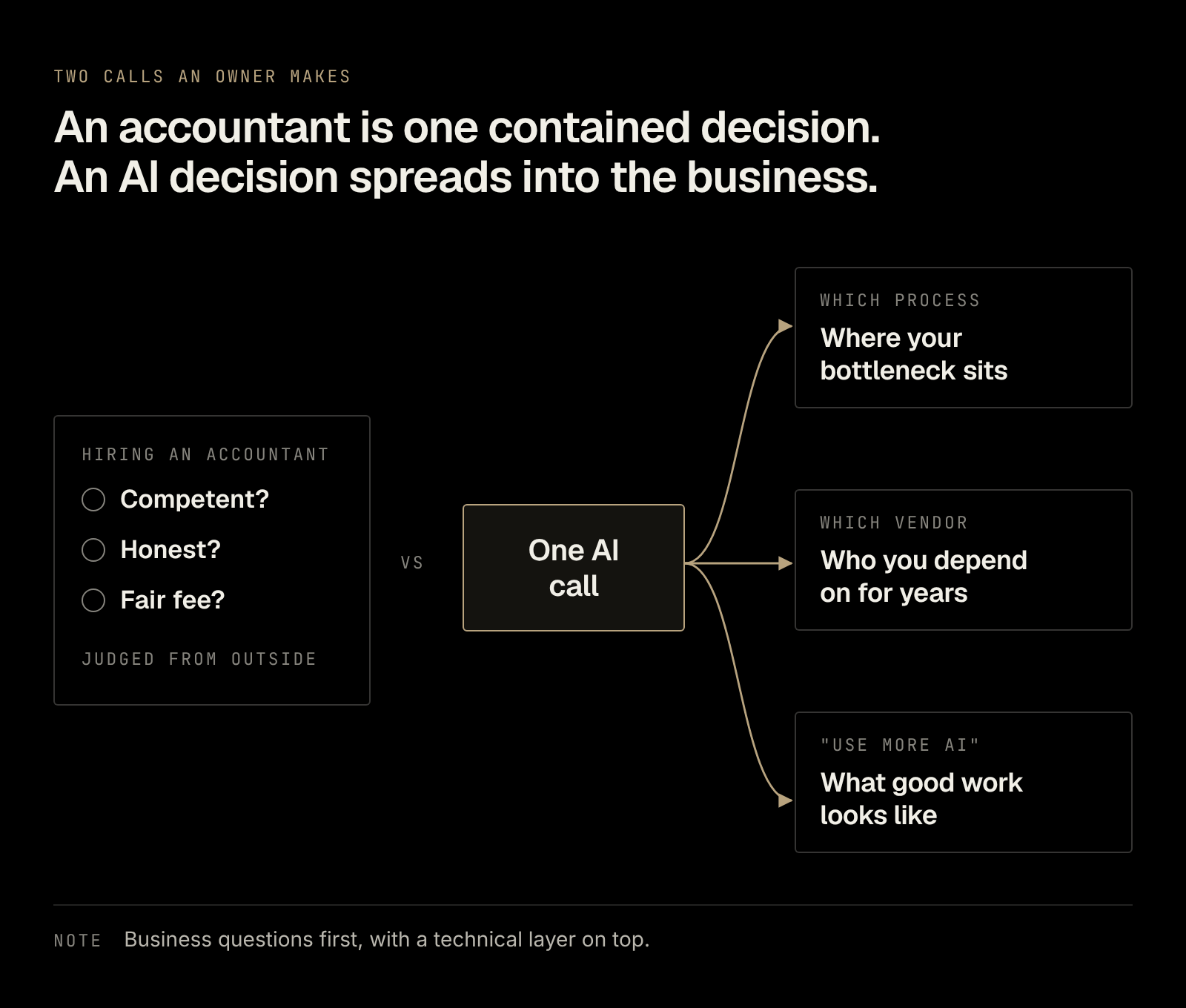
Those are business questions first. There's a technical layer on top, and if you can't see through it, somebody else ends up answering the business question for you. Usually that's whoever sounds most sure of themselves.
I've been building AI software since generative models arrived, and the pattern I keep running into is owners who can't tell a good AI proposal from a bad one. These are sharp people, and plenty of them run businesses much bigger and older than mine. But they mix up a chatbot with an automation, and an automation with an agent, so two proposals that look alike on paper can be completely different builds with no way to compare them. A polished answer gets read as an accurate one. A prototype gets approved before anyone has asked how much work sits between it and something the team could run every day.
That last gap costs money. A demo is put together for one meeting, while production has to cope with the supplier who sends a scanned PDF upside down and the customer who writes in Arabic and English in the same email.
Everyone you hand it to wants something
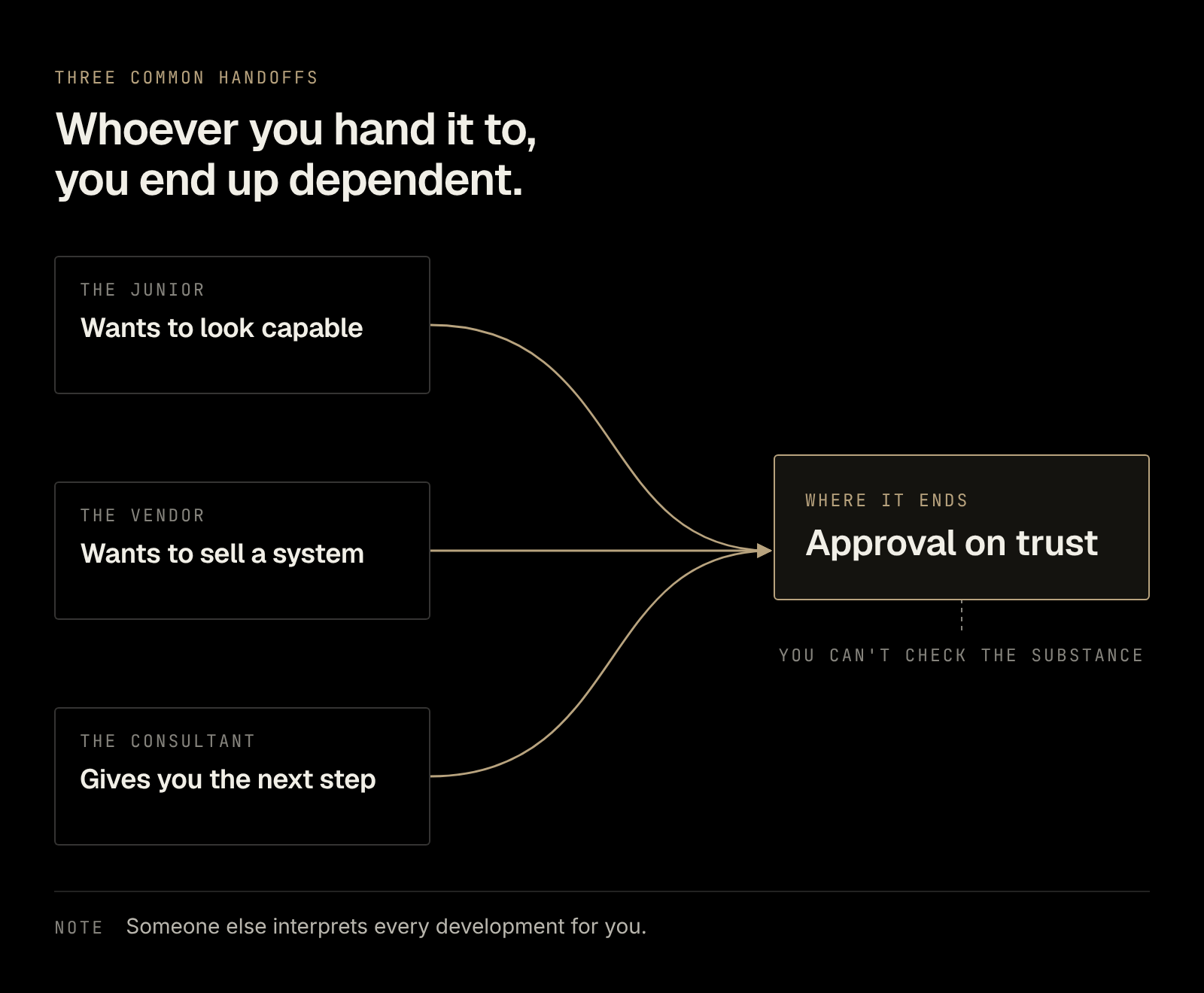
Nobody in this picture is acting in bad faith. But each person you might hand AI to has a reason to steer you somewhere.
Take the junior who shows you an impressive workflow. They want to look capable, which is fair. What they've built may be useful, or it may break the first time an input is odd. If you can't judge it, you'll either back it blindly or kill it out of caution, and both of those are guesses.
A vendor wants to sell you a system. That's their job. Every proposal they write rests on assumptions about scope and about who owns the result after launch. If you can't find those assumptions, you end up comparing headline prices. Then, after you've paid for the cheaper one, you find out you can't change anything without going back to them. I think a lot of long-established businesses have overpaid for AI training and software for exactly this reason: nobody in the room could say what the thing should cost.
Even a good consultant, who will tell you clearly what to do next, rarely leaves you able to work out the following step yourself, and with AI there's always a following step; a strategy deck written while you stayed out of the work goes stale the month a new model ships. So whoever you hand it to, you end up dependent. Someone else interprets every development for you. You approve or reject on trust because you can't check the substance yourself. For a person who built a company on their own judgment, that's an odd place to end up.
The pressure on owners went up this year
If AI had stayed in pilot projects, this would be a slow problem. It's moved well past that now.
Big companies have spent two years running pilots with thin returns. In October, Gartner surveyed CIOs and found that only 13% could point to large or transformational value from AI so far. Alicia Mullery, the Gartner analyst who presented it, summed it up as "Volume is not value." The detail I liked was smaller: the companies doing better had written rules for when to stop an AI project, and few had any. Stopping is a budget decision, so it falls to whoever controls the budget.
Meanwhile AI agents, meaning software that takes a task and works through the steps itself, have moved out of pilots and into daily operations at a growing number of firms. I think agents are useful. Somebody still has to decide what an agent can touch and at what point it stops and asks a person, and a tool can't make that decision about itself.
In the Gulf the push is coming from the top. The UAE wants half of its federal government work running on AI agents within two years. On 12 October, eleven Dubai companies (Emirates and DP World among them) signed a Dubai Chambers pledge to put agents into their own operations. If you sell to government, or to the big groups that follow its lead, your customers will expect you to keep pace. Vendors will show up with pitches written in the language of those programmes, and an owner who can't test a pitch tends to buy whichever one sounds closest to the announcement.
None of this means you should follow the news more closely. If anything I'd tell you to read less of it. Owners I'd most like to work with tend to read about AI more than they use it, and each new release makes them wonder whether what they learned a few weeks ago is already out of date. The news is background; you need a way to judge any of it against your own business.
Objections I'd push back on
The common response is "I'll hire someone for this." You probably should at some point, but write the job description first and see how far you get. If you can't say what an AI hire would be responsible for, you'll end up interviewing on familiarity with popular tools and getting impressed by a demo. Judging a candidate in a field you can't evaluate is guesswork, and it gets a lot easier once your own judgment is in place.
Another is that it all changes too fast to learn. The tools do change constantly. But the reasoning underneath has hardly moved since I started: you define what a good result looks like before you begin, and you check the answer against something other than the model that produced it. Deciding which steps need a person hasn't changed either. None of that expires when a new model ships, and it's what makes the next tool quick to judge.
Then there's "I'm not technical." You don't need to be, and I'd say technical depth is the wrong goal for an owner. You need to know where AI helps in your business and where it tends to fail. You also need to be able to tell whether someone else knows what they're doing with it. That's the same kind of call you make about your finance team or your factory floor.
The objection I take most seriously is time. My answer is that you're spending the time anyway, in meetings about proposals you can't assess and in reworking output nobody defined properly. Putting some of those hours into your own method costs less.
Owning the judgment, day to day
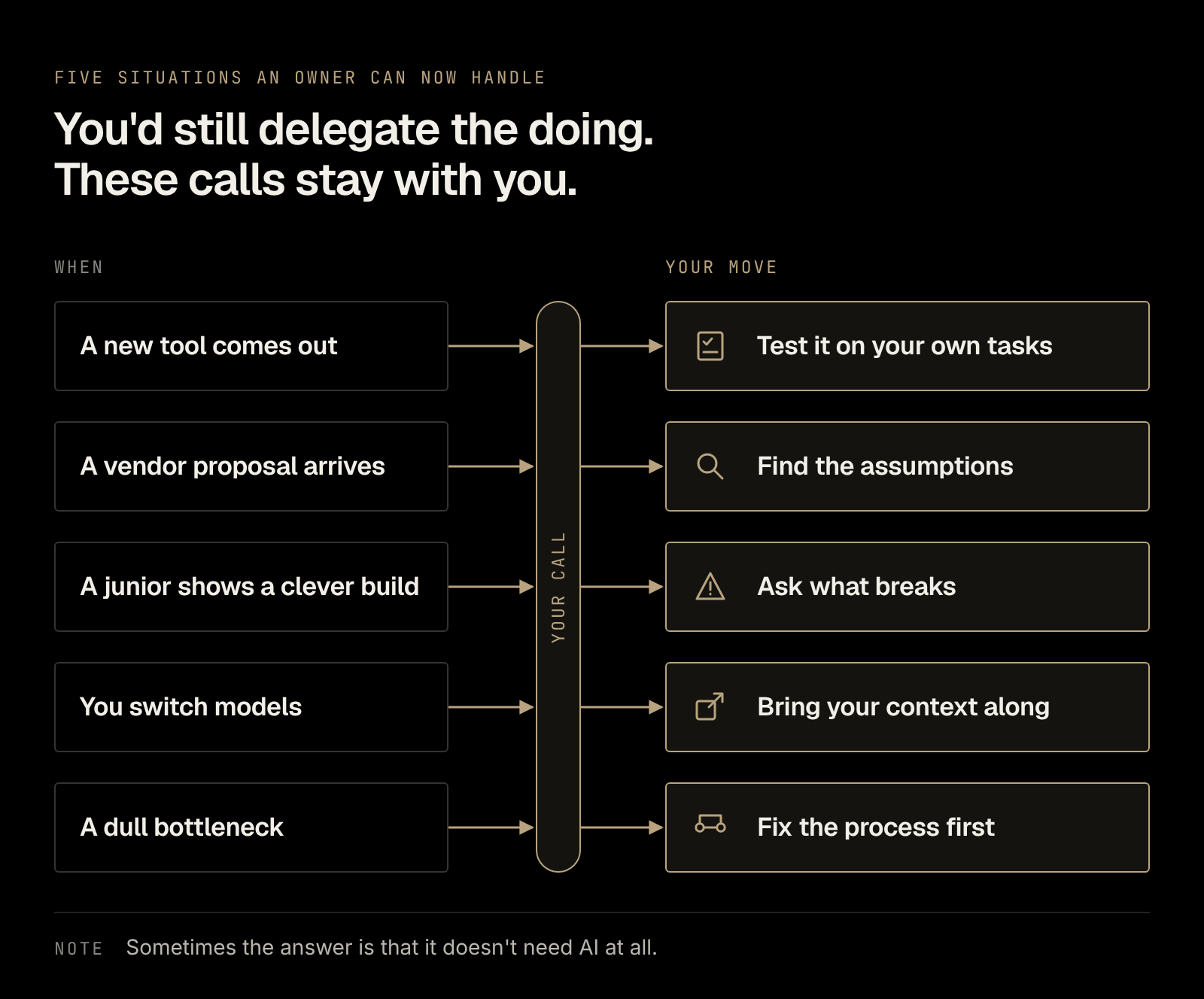
You'd still delegate most of the doing. The difference is a short list of things you can now handle without help.
Say a new tool comes out. You can run it on three or four of your own recurring tasks in an afternoon with the same instructions each time, then decide whether it's worth paying for. When a vendor proposal arrives, you can point to the assumptions that decide whether it works. Sometimes the answer is that it doesn't need AI at all. Ordinary software or a cleaner process would do the job.
When a junior shows you something clever, you can ask what happens when an input is missing and who checks the output before it reaches a customer. And when you tell your team what better work looks like, they'll know you've produced it yourself.
The context your business runs on, like your pricing logic, shouldn't live inside a vendor's tool or one employee's head. If you switch models next year, it should come with you.
It also pays to start with the dull bottlenecks. Automating a process nobody has defined just reproduces its problems at higher speed. Fix the process first, then decide which steps belong to a person and which go to software or AI.
Private AI Capability
We built Private AI Capability at Zach AI for owners in exactly this position. It's a six-week, one-to-one engagement for a single founder or senior operator, based on their own work. Before the first session we take a baseline across ten capabilities using real tasks from your role, and we pick three pieces of your work to build the six weeks around. Each week has a private 75-minute session on a live task or decision, with two check-ins between sessions.
At the end you're reassessed on tasks you haven't seen, so the result shows what you can do on new material. If something didn't improve, the report says so. You keep what you built in your own workspace, so the method stays with you after the engagement ends.
The engagement covers one person, and if you want a system built for you, that's quoted separately.
If you're tired of signing off on AI decisions you can't judge, the first step is a private 30-minute conversation. You can book it at zach-ai.com/capability.
Frequently asked questions
- Can an owner delegate AI work at all?
- Yes, most of the doing. The calls about that work should stay with you: which process to automate, which vendor to depend on, and what good work looks like in the company.
- Should I just hire someone to handle AI?
- You probably should at some point. Write the job description first. If you can't say what an AI hire would be responsible for, you'll end up interviewing on familiarity with popular tools and getting impressed by a demo. Judging a candidate gets a lot easier once your own judgment is in place.
- Do I need to be technical to make good AI decisions?
- No. You need to know where AI helps in your business and where it tends to fail, and to tell whether someone else knows what they're doing with it.
- Doesn't AI change too fast to learn?
- The tools change constantly, but the reasoning underneath has hardly moved. You define what a good result looks like before you begin, check the answer against something other than the model that produced it, and decide which steps need a person. None of that expires when a new model ships.
- How do I compare two AI proposals?
- Find the assumptions about scope and about who owns the result after launch, instead of comparing headline prices. Then ask how much work sits between the prototype and something your team could run every day. Sometimes a proposal doesn't need AI at all, and ordinary software or a cleaner process would do the job.
- What is Private AI Capability?
- A six-week, one-to-one engagement for a single founder or senior operator, built around three pieces of their own work. It starts with a baseline across ten capabilities, has a private 75-minute session each week with two check-ins between sessions, and ends with a reassessment on tasks you haven't seen.