Learning AI as a business owner
Practise on three pieces of your own monthly work for six weeks, with a score to beat. Then read each new release only for whether it changes one of them.
On this page
- Did you need this month's news?
- Can a demo or a course teach you this?
- Which three pieces of work should you practise on?
- Does this take much time?
- Can you tell if you're getting better?
- Is the next big release worth your time?
- Isn't it changing too fast to bother?
- Is this the wrong fit for you?
- Learning it with the Zach AI team
- FAQ
Learn it on your own work, with a score to beat. Pick three pieces of work you do or sign off yourself every month and use one AI tool on them for six weeks, keeping a short note after each attempt. Test yourself on each one before you start. At the end, test again on a fresh example you haven't practised. Follow the news only far enough to ask whether a release changes how you'd do one of those three tasks, and in most weeks it won't.
I'd say that to any owner of a 30 to 200 person firm who feels behind, because the feeling of being behind usually comes from reading about AI, and reading is the slowest way I know to get good at it.
Did you need this month's news?
Look at what landed in two weeks. Google released Gemini 4 Carbon on 10 November and called it its strongest model, even though Gemini 4 Argon had only just come out. A week later Microsoft used its Ignite conference to put new Copilot features on general release and start rolling out one called Autopilot to its Frontier customers, and on the same day OpenAI launched ChatGPT for Sales with more than 30 partner plugins for tools such as Salesforce and HubSpot. Each was serious work, which is why each got written up as something every business needed to understand.
Take a building materials distributor in Houston with 120 staff. I doubt any of those releases changed what its owner should do on Monday morning. But an owner who read about all of them probably came away feeling that whatever they'd started with AI was already out of date. I see that worry in owners all the time. Every release makes them wonder whether their approach is already old. So they read more and try less, until the next release resets the clock.
The cure is to give your attention to something that holds still, and your own recurring work holds still. The tender review you sign off every month will look much the same next quarter, whichever model is in the headlines.
Can a demo or a course teach you this?
Only up to a point, because a demo runs on someone else's work. You see a clean request and a clean answer on documents you've never touched, which teaches you what the tool can do on a good day for a stranger. It tells you nothing about where it goes wrong on your material, and that's the knowledge that pays off inside your firm.
Courses have the same gap, even good ones. People finish one and feel capable for a week. But when they try it alone they can't get the same result, since the course never used a file they'll see again.
What an owner needs from AI is narrower than most courses assume. You need to get a usable first draft out of it on work you know well, and you need to catch a wrong answer before anyone acts on it. That second skill only grows on work where you can already tell right from wrong. So the training ground has to be your own work, with you at the keyboard. Sitting beside the person typing doesn't build it.
Which three pieces of work should you practise on?
I'd hold each candidate to four tests. It should come round at least once a month, so six weeks gives you enough attempts to see a pattern. You should know what a good result looks like, because otherwise you can't judge the tool's answer and you'll end up trusting it. You should do it or sign it off yourself, since a report your manager writes and summarises for you only teaches the manager. And it should be work you're allowed to put into the AI account the company pays for, which rules out anything under a confidentiality clause nobody has read.
The second test is the one I'd never relax. If you can't tell a good answer from a bad one, the practice has nothing to push against.
For the managing director of a logistics company, the three might be the weekly exceptions report, the letter to a customer after a delayed shipment, and the monthly review of carrier rates. A clinic owner might pick the monthly note to referring doctors and the summary of patient complaints, then add a staff rota with three people on leave. For the owner of a precast concrete plant it could be the monthly quality summary, where years on the floor tell you which defects keep coming back.
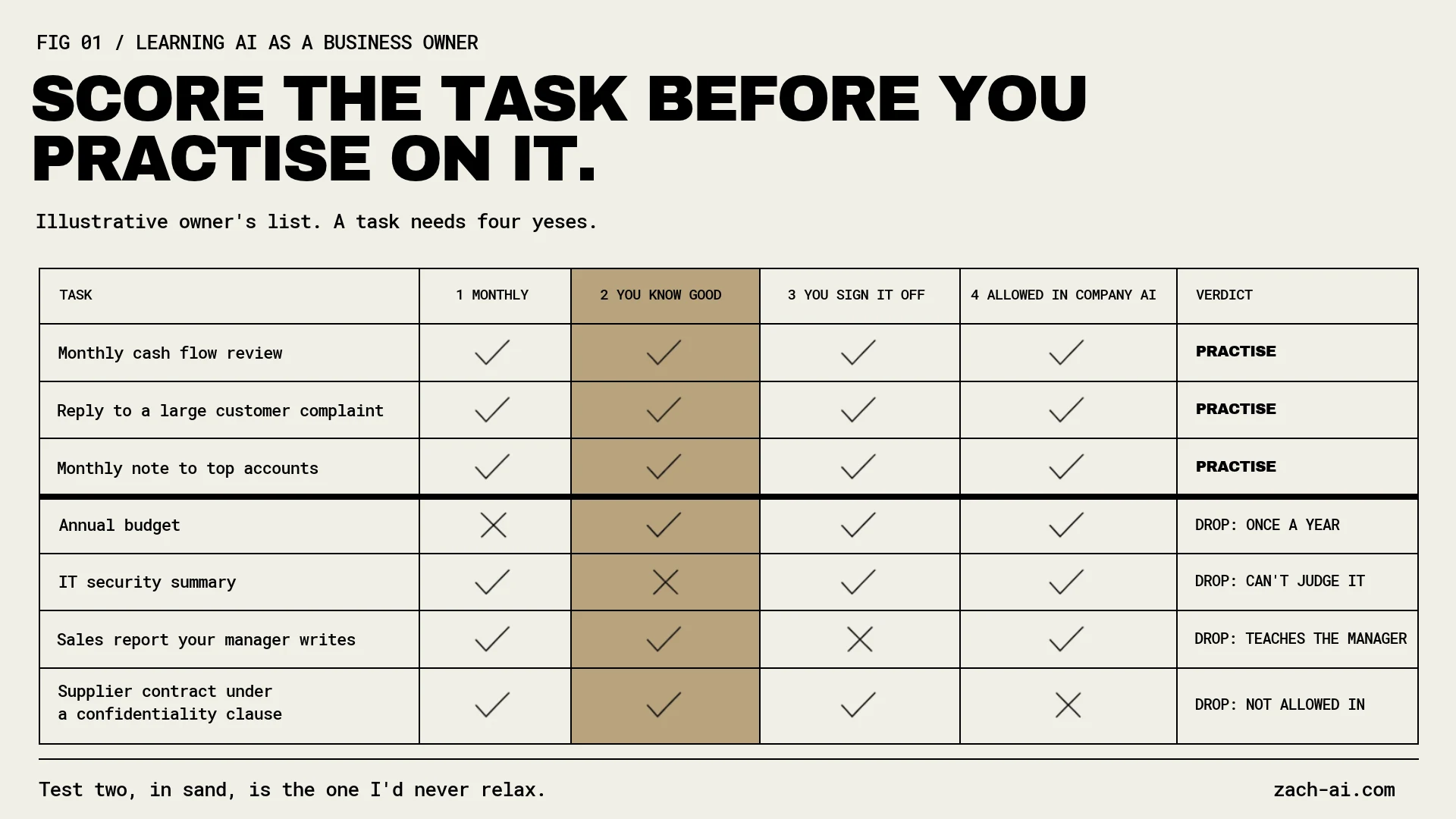
Three is enough to show you where the tool is strong and where it keeps failing, and few enough that you'll still do all of them when the month gets busy.
Does this take much time?
Less than people expect, because you'd be doing the task anyway. Use the tool when the real work arrives, instead of setting aside an afternoon to experiment. The extra time is the note you write afterwards, in four short lines: what you asked, what came back, what you had to change, and whether you'd have spotted the mistake if you hadn't already known the answer.
That note does most of the teaching. After a month you'll see the same failure come back, maybe a total it drops or a date it misreads, and you'll start asking for the work differently. Without the note, every attempt feels like the first one.
Stick to one tool for the six weeks. A habit I see in owners is switching tools the moment an answer disappoints them, without working out why it failed. Most failures come from what the tool was given, such as a vague request or a missing document, so they follow you to the next tool. When you stay put, you can see the cause.
Can you tell if you're getting better?
You can, if you take a baseline before week one, because without it you can't separate progress from a lucky month. Do one example of each task cold with the tool. Keep the result, with a line on what you had to fix. At the end of week six, do it again on a fresh example of each task that you haven't practised. The fresh example is the point, since repeating the same one only teaches you that one file.
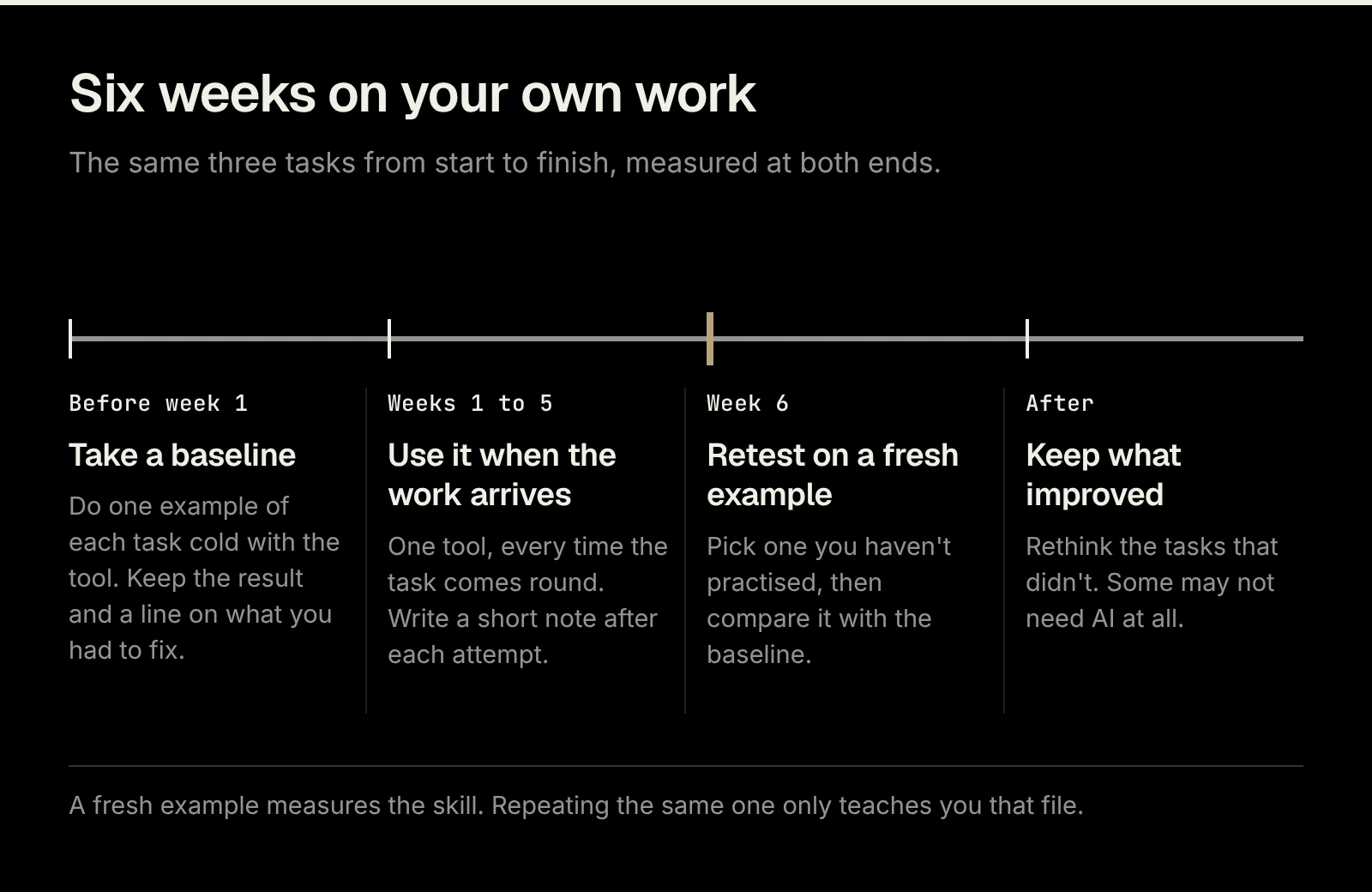
Some tasks won't improve, but I'd still count that as a result. If the tool never got the carrier rate review right in six weeks, you've learned something a vendor may not tell you. Maybe that task doesn't need AI at all. I'd want to know that before paying anyone to automate it.
Is the next big release worth your time?
Usually not, and one question tells you which ones are. Ask whether it touches one of your three tasks, and let it go for now when the answer is no. When it does touch one, check whether it's available on the account you already pay for. A release that isn't goes on a list you look at again after your six weeks. One that is gets run on the same example you used last, and you compare the result with your note. That comparison takes about as long as the task itself, but it tells you more than every review written about the release.
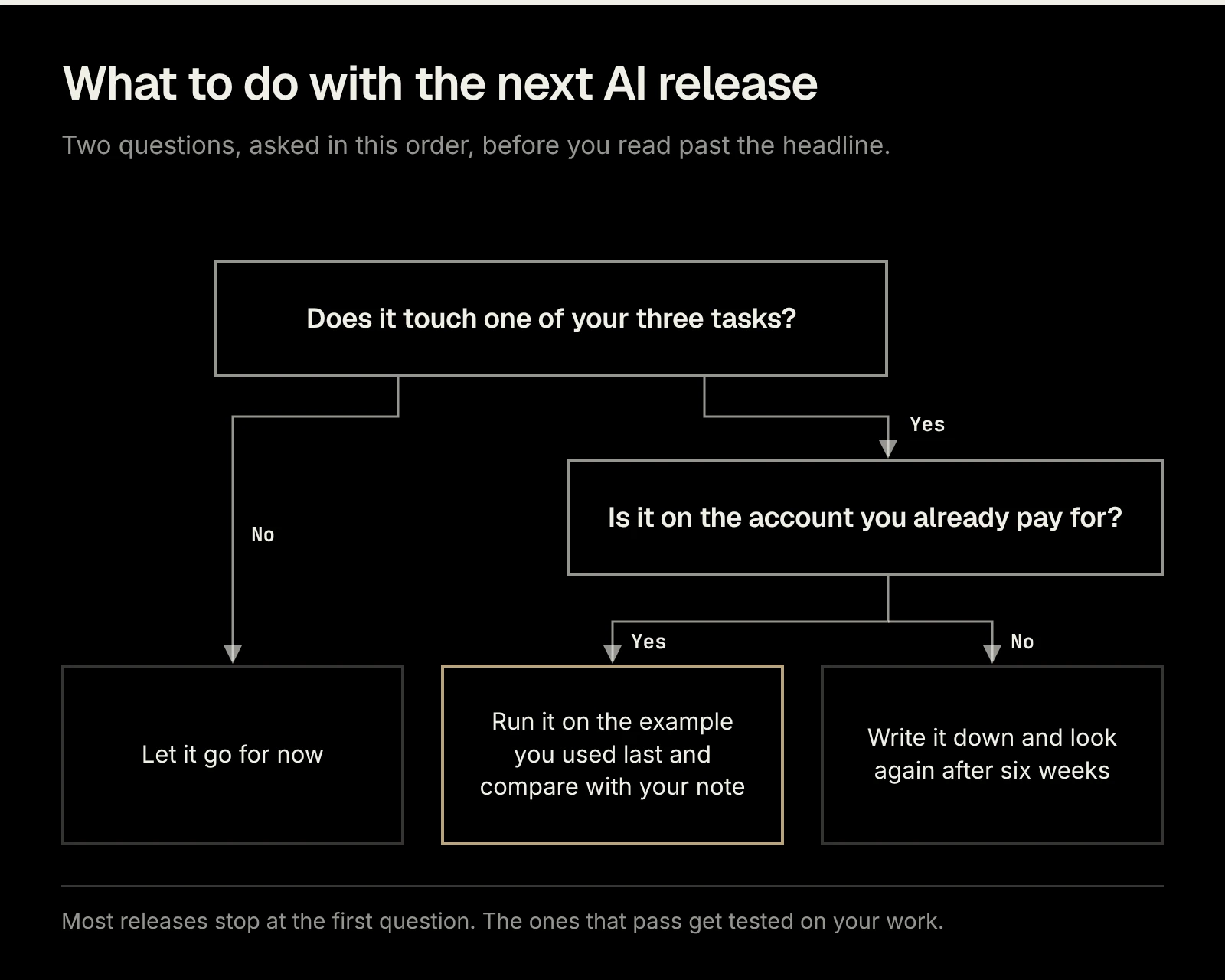
Put this month through that filter. Gemini 4 Carbon is a stronger model, so it's worth a try only if your current tool keeps failing one of your tasks on reasoning, and only if your company can reach it. ChatGPT for Sales is worth a look if one of your three tasks lives in your CRM and your account is a Business or Enterprise plan whose admin switches it on. For a firm whose three tasks sit outside the CRM, both stop at the first question.
The release I'd read twice came from OpenAI on 23 November, and it's barely about software. OpenWorks pays local AI practitioners to sit with small business owners on a project the owner chooses, and the help page tells owners to start with one task they'd like to make easier. It's limited to independently owned US small businesses in 20 pilot communities, so most readers here can't join it. But I still find it telling. The company with the most to gain from you reading its release notes is paying people to teach owners in person, on one real task.
Isn't it changing too fast to bother?
The tools change, but your three tasks don't, which is why the note stays useful when a new model arrives. You rerun one example against your note and know within an hour whether the new version helps you. An owner without that note has only the vendor's word for it.
Another objection I hear is "I'm not technical." None of the four tests needs technical skill. They need you to know your own work, and you know it better than anyone you could hire to learn AI on your behalf.
Is this the wrong fit for you?
It is if you'd rather someone else understood AI so you never have to, because this approach only suits owners who want their own judgment about it. You'd do better hiring a capable operator and accepting that you'll judge their AI work on trust. It also fails if you only open the tool when someone is sitting with you. Six weeks of good intentions without the attempts leaves you where you started, with a longer reading list.
Learning it with the Zach AI team
If you want a structure around this, Private AI Capability is built on the same idea. Before the first session we measure where you stand across ten capabilities, and then the team works with you one to one on three pieces of your own work for six weeks, with two check-ins a week between sessions. In week five we build one working agent with you on a real task. In week six we retest you on tasks you haven't seen, and the report says what improved and what didn't. You can see how it works and book a private conversation at zach-ai.com.
FAQ
- Can a business owner learn AI without a course?
- Yes, by practising on your own recurring work. Pick three tasks you do or sign off yourself every month and use one AI tool on them each time they come round for six weeks, with a short note after each attempt. Test yourself before you start and again on fresh examples at the end.
- Is six weeks enough for a CEO to learn AI?
- It's enough to see whether you've improved on the tasks you practise, because the retest on fresh examples shows it, as long as you use the tool each time the work arrives. Most of the time is the work you'd be doing anyway. The extra time is a short note after each attempt.
- Do I need technical skills to learn AI as an owner?
- No, because the skill an owner needs is getting a usable first draft from the tool on work you know well and catching a wrong answer before anyone acts on it. Both depend on knowing your own business.
- Should an owner try to keep up with AI news?
- Only through one question: does a release touch one of the tasks you use AI on? If it doesn't, let it go. If it does and it's on the account you already pay for, test it on an example you've already done and compare the result with your notes.