Should you stop hiring juniors because of AI?
A junior seat produces work, teaches your standard and grows tomorrow's supervisors. AI may take the first. Test it on your own files, then decide the other two on purpose.
On this page
Not on the strength of a headline, and not before you've tested it on your own files. A junior seat in your firm does three jobs: it produces work, it teaches one person how your firm decides what good looks like, and it grows whoever will supervise the AI's output once there's more of it. AI may well take over part of the first job, and a test on your own work will show how much. It can't take over the other two. Cutting the seat settles both without anyone having chosen to.
If you run a firm of 30 to 200 people, that choice should be yours, made on evidence you gathered.
On 19 November, MHA, an accountancy group listed in London, put the question in numbers. Its chief executive told City AM that the group took on 200 juniors in its latest hiring year from about 10,000 applications, against 350 two years earlier, and that AI is moving the firm "from pyramid towards diamond". Its half-year results came out the same day and gave AI and automation part of the credit for a 14% rise in adjusted earnings, with client demand the other part. He also said the group's IT costs have climbed from 5% to roughly 7% or 8%, so the saving comes with a new cost line.
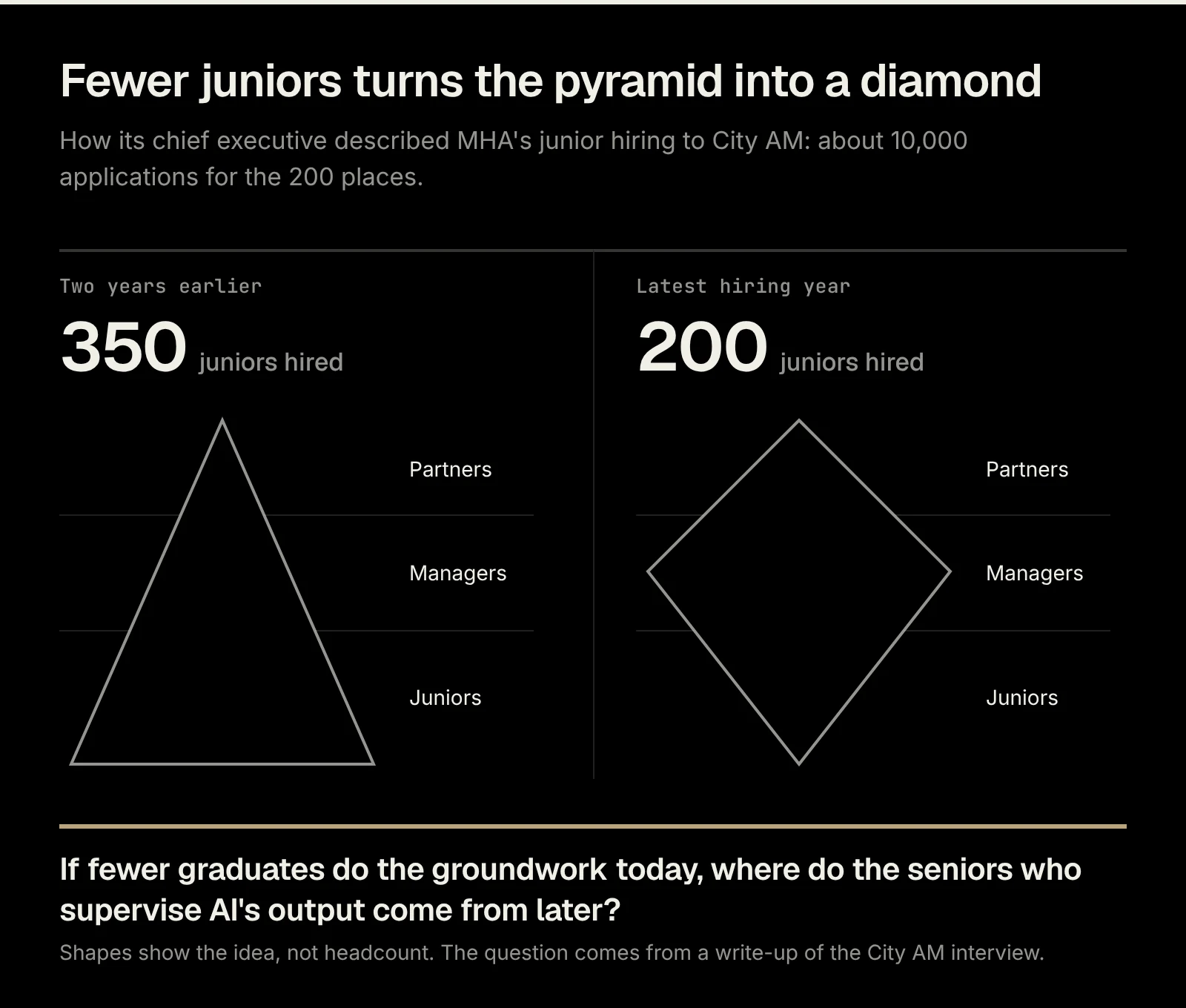
I'm not telling MHA it's wrong. It's a far bigger firm with its own data. You have a few dozen to a couple of hundred people and probably no record of which of your juniors' tasks a model handles well, and that's the gap I'd close before touching a hiring plan.
Is a junior seat only the work it produces?
Output is the job everyone sees, because it is the one that shows on the timesheet. A graduate engineer checks supplier documents against the specification, an associate drafts the first version of a client report, a trainee writes up a site visit, and a senior reads it and corrects it. A model can plausibly do part of that, but only your own files can say which part.
The second job is harder to see. Each correction a senior makes teaches the junior something the firm never wrote down, such as what a good client finds acceptable, which shortcut is fine on this job and wrong on that one, and what makes you uneasy about a number. I know this from the receiving end. My first client outside India came through a friend's referral when I was nineteen, and the early work was unpaid, but those months taught me what a client counts as good work, and I was head developer on those projects later. A document couldn't have given me that.
The third job only shows up once you rely on AI. Somebody has to read what the system produced and recognise that it's wrong, and that judgment comes from years of doing the first pass yourself. A write-up of the MHA interview asks where the people who supervise AI's output will come from in ten years if fewer graduates do the groundwork now. Chris Simmance, writing in the Observer, puts it more bluntly: "If you've never been a junior something, you can never be a senior anything."
Is AI the reason you'd cut, or the reason you'd give?
Sometimes the honest reason for hiring fewer people is money. That's a perfectly good reason. Payroll costs more than it did, or a partner is retiring and you'd rather not replace the layer beneath. I'd rather you said that to yourself than borrowed a better-sounding explanation.
The borrowing is common enough to show up in surveys. BSI polled 1,287 business leaders in nine countries and published the results on 17 November, and it found that 54% say AI is helping to reduce their headcount, up from 41% a year earlier. A further 53% say it is being used to justify cuts and hiring freezes, which suggests the explanation sometimes arrives after the decision. The Observer piece makes a similar point, reporting that the executive director of Yale's Budget Lab has suggested some chief executives credit AI for cuts that tariffs and interest rates also help explain.
When AI is the stated reason, you've skipped the step that would show whether it's true, which is checking that a model can do the work. If it can't, you have removed a seat and passed the work to your managers, who now do it in the evening, and you'll see it in their hours before any report shows it.
Can you test what AI would take from a junior?
You can, using your own finished work, because it already has the right answers on file. Say you run a 90-person engineering consultancy in Abu Dhabi, and your graduate engineers spend their first year checking supplier documents against the specification. Ask the graduates, not their managers, to list what they did in a typical month, since they know what the job is.
Then pick one task that repeats and pull 15 or 20 completed examples where a senior's corrections are on file.
Give the AI the original documents with no hints, then lay its output beside what your senior caught and count the problems it missed and the ones it made up. Both counts matter, since a made-up problem costs a senior time to disprove, but a miss that reaches a client costs more.
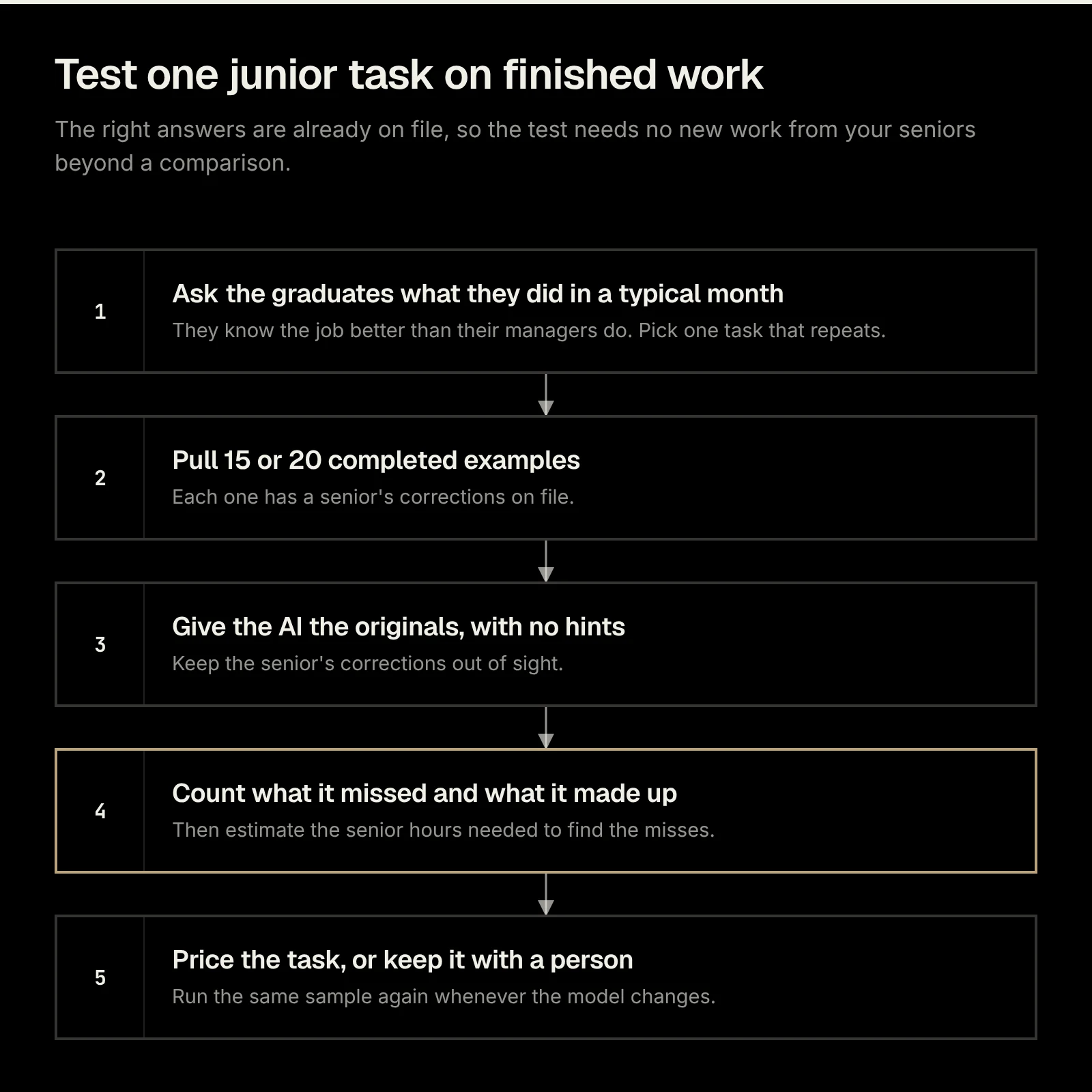
Then estimate the senior hours needed to find what the model missed. Say it misses a handful out of twenty and each one takes a senior ten minutes to find, then you can price the task. If it misses half, you've learned that in an afternoon, before a seat disappeared.
That sample doubles as a baseline. Run it again when the model changes, which, as I wrote in the piece on running costs, happens on the provider's schedule and not yours. The test costs a modest slice of one senior's time, but a wrong hiring plan takes years to undo.
Which seats stay on purpose?
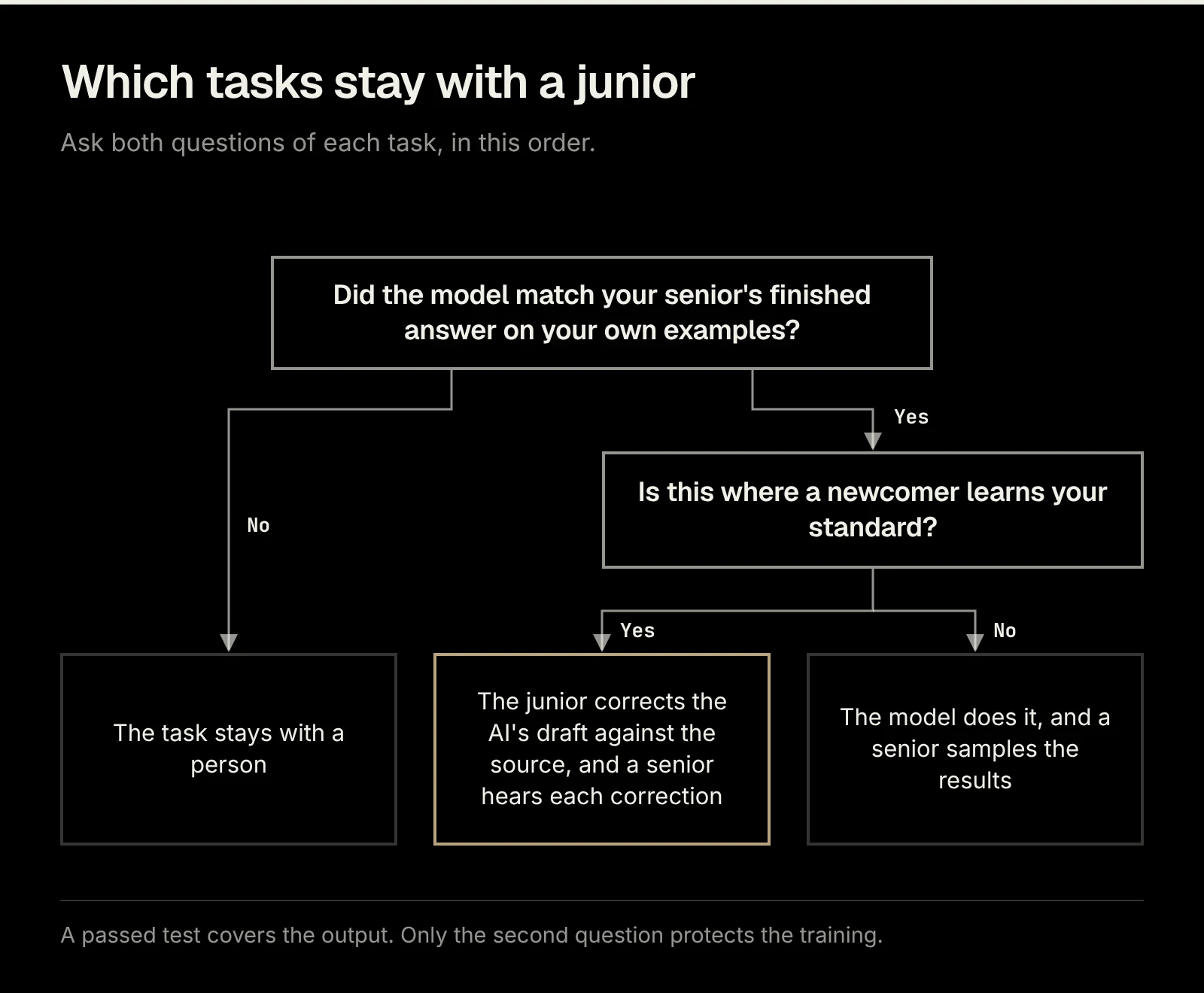
A passed test covers output and nothing else, and the task the model does well may be the very one where your juniors learn your standard. So I'd ask of each task whether the model matched your senior's finished answer, and whether this is where a newcomer learns how you judge work.
If the model fell short, the task stays with a person. If it passed and the task teaches something, I'd keep it with a junior and change the job: the junior gets the AI's draft, marks it against the source, and explains each correction to a senior in a few minutes. The junior keeps learning, and the output still arrives faster. If it passed and nobody learns anything from the task, let the model do it and have a senior sample the results.
There's an obvious objection, which is that you can hire juniors again once things settle. I wouldn't count on it. The Observer's point is that a job lost because demand fell can return with demand, while one lost because its tasks were automated usually doesn't. Supply isn't the bottleneck either, since MHA had about 10,000 applicants for 200 places. What you would run short of is your own capacity to train people, and that fades when nobody sits in the seat to be trained.
The same BSI survey found that 49% of leaders worry career starters aren't developing the right skills because they ask AI instead of a manager. In a firm your size you can fix that, because a senior who sits with a junior for fifteen minutes after each AI draft supplies the training that the shortcut skips, though somebody has to be given that time.
Should the hiring plan name a trainer?
It should, and I'd treat that as the test of whether the plan is finished. For each junior seat, write down which tasks AI is cleared for, with the date of the test and the sample behind it, and which tasks stay with the junior and what each one teaches. Then name the senior who trains the person in that seat, and if you can't, the cut isn't ready, whatever the model scored.
Hiring fewer juniors can be the right call, and for some firms it will be. A firm that hires four fewer graduates because a test showed two of their tasks are covered and the rest need people has made a decision. A firm that hires four fewer because the news said so has borrowed somebody else's.
If you'd like to run this comparison on your own files with someone who builds these systems every day, Private AI Capability is where we work one to one with a founder or senior executive for six weeks on their own tasks. It begins with a baseline before week 1 and ends with a reassessment on tasks the tools haven't seen, which is the same order of work as the test above.
FAQ
- Should I stop hiring junior staff because of AI?
- Not until you've tested it on your own work. Take one repeating task, run the AI on 15 or 20 finished examples that already carry a senior's corrections, and compare the results. After that, decide seat by seat, because the tasks where newcomers learn how your firm judges work should stay with them.
- Can you test whether AI can do a junior's task?
- Yes, by giving it finished examples with no hints and comparing its output with what your senior caught. Count what it missed and what it invented, then estimate the senior time needed to find the misses. The same sample works as a baseline when the model changes.
- Will you have managers later if you hire fewer juniors?
- Only if you train the juniors you do hire, so the training has to be deliberate. Keep the seats where people learn your standard, have them correct the AI's drafts against the source, and have a named senior explain each correction.
- Is AI the reason companies are cutting junior hiring?
- Sometimes, but it is also the stated reason for decisions made on cost. BSI's poll of 1,287 leaders found that 53% say AI is being used to justify cuts and hiring freezes. If cost is your reason, say so. Decide on that, then run the test to see what AI can cover.